A focus on the formative
From:China DailyAuthor: 2024-03-04 11:04
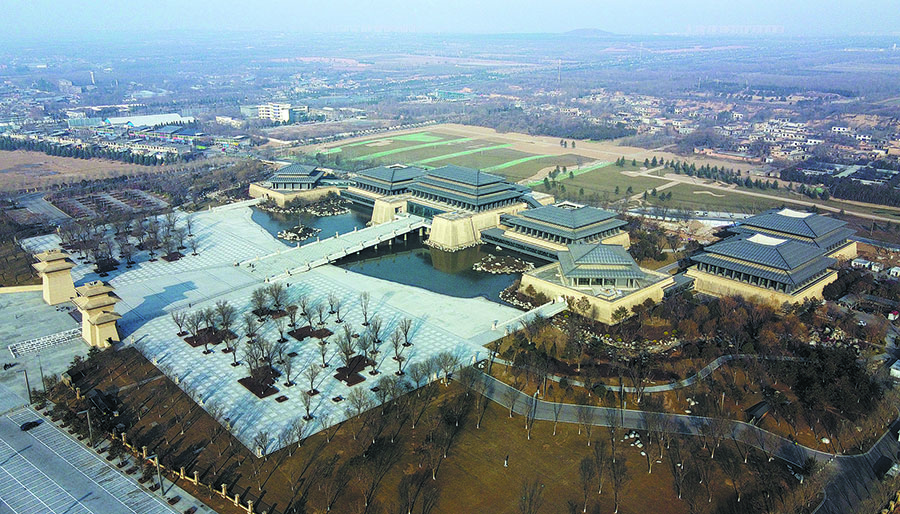
A bird's-eye view of the newly opened Shaanxi History Museum's Qin-Han Civilization Museum in Xixian New Area, Shaanxi province.[PHOTO BY ZOU HONG/CHINA DAILY]
New branch of the Shaanxi History Museum places achievements of Qin and Han dynasties in wider context, Wang Ru and Qin Feng in Xi'an report.
As they pass through the doorway between two towering quelou — traditional ceremonial gate towers — and walk up the 90 steps to the main building of the Shaanxi History Museum's new Qin-Han Civilization Museum, visitors may experience a sense of solemnity as they arrive at the complex, which is based on Qin (221-206 BC) and Han (206 BC-AD 220) dynasty palaces.
Designed by architect Zhang Jinqiu, who is also an academician of the Chinese Academy of Engineering, the buildings resemble traditional Qin and Han dynasty palaces, which were often built on high, rammed earth platforms.
As the first museum in the country specially dedicated to the Qin and Han dynasty civilizations, this branch of the Shaanxi History Museum is currently in a soft opening and will officially welcome visitors in May.
"If the Shaanxi History Museum is seen as a great overview of Chinese history, then its Qin-Han Civilization Museum is the volume dedicated to the Qin and Han," says Ren Xueli, director of the Shaanxi History Museum's exhibition department.
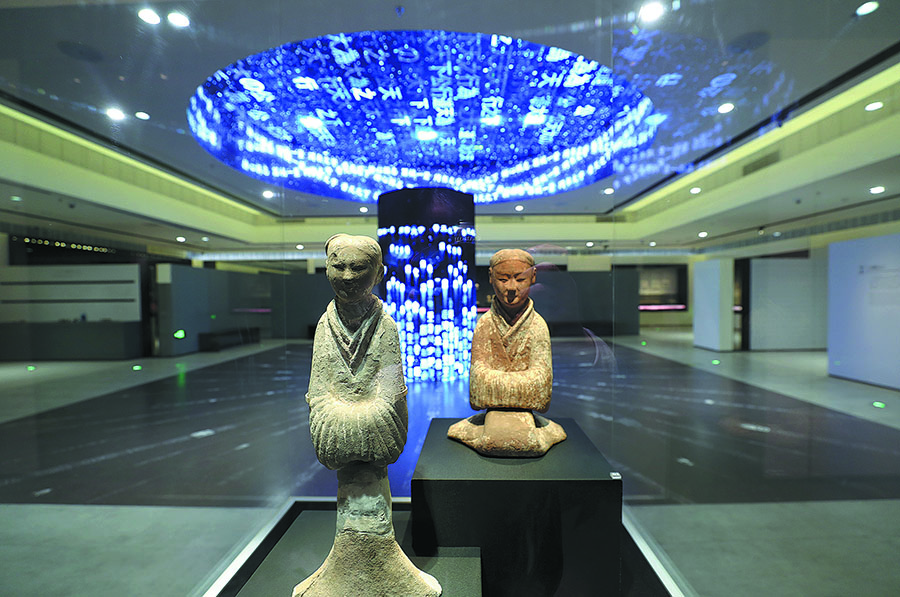
Two pottery figurines against the backdrop of a multimedia device, which illustrates the transformation of Chinese characters.[PHOTO BY ZOU HONG/CHINA DAILY]
The new museum is located in Xixian New Area neighboring the ruins of the central palace area of ancient Xianyang, the capital of the Qin Dynasty, and the location of the mausoleums of Western Han (206 BC-AD 24) emperors.
"In some way, the buildings are the biggest exhibits," Ren says.
There are seven buildings in all, laid out in the shape of the Big Dipper. This is a representation of xiangtian fadi, the traditional practice of making a city layout, according to celestial positions, Ren says.
"During the time of Qinshihuang (China's first emperor), Xianyang was laid out according to the positions of the stars. By the time it was completed, the city extended along both the north and south sides of the Weihe River, and the river was seen as a representation of the Milky Way. Zhang Jinqiu designed the museum based on the same idea," Ren continues.
The buildings are connected by overhead corridors, much as they would have been in ancient times, but these corridors are made of glass curtain walls and provide good views of the outside. This, Ren says, is a combination of the old and new.
During the Qin and Han eras, the imperial family had royal gardens where they could hunt and appreciate landscapes. For example, Western Han poet and musician Sima Xiangru described the views and animals in one large royal garden, the Shanglin Garden. The museum has re-created some of those views.
"The overall design is imbued with deep meaning and a sense of romance. The beautiful architecture faithfully reproduces ancient literary depictions, and allows people to experience the beauty described in literary works for themselves," Ren says.
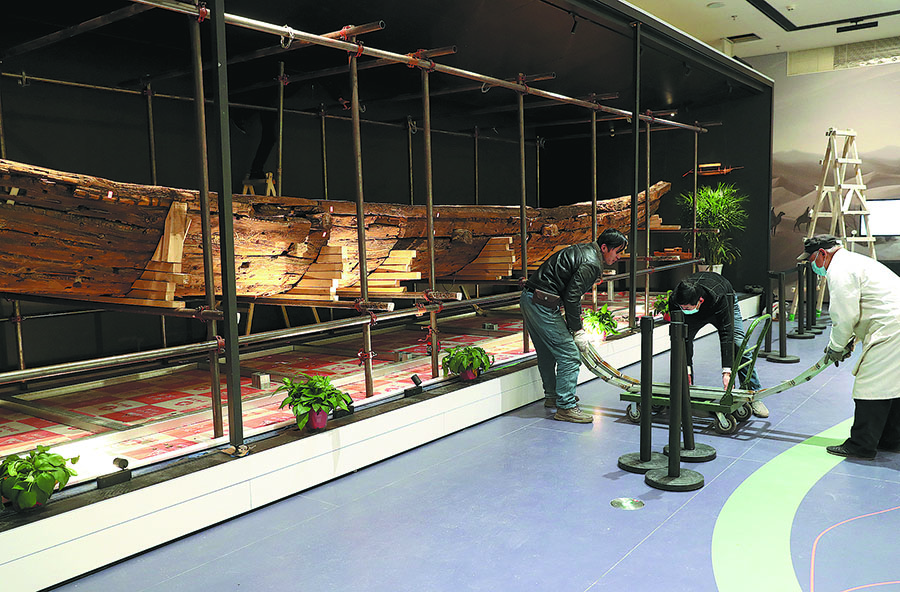
A Han Dynasty (206 BC-AD 220) wooden vessel on display undergoes repairs in January.[PHOTO BY ZOU HONG/CHINA DAILY]
The buildings will be used as exhibition halls, a library, a cultural relic protection center, a restaurant and an activity center, and will become a cultural and tourist complex, she adds.
Many ancient dynasties had their capitals in Shaanxi, in particular the Western Zhou (c. 11th century-771 BC), the Qin, the Han, the Sui (581-618) and the Tang (618-907) dynasties.
"These dynasties exert a very important influence on modern China. The rituals and music system of the Western Zhou Dynasty, the political systems of the Qin and Han dynasties, and Sui and Tang's governing policies with their spirit of openness, inclusiveness and peaceful communication with foreign countries, have all been important influences on Chinese civilization," Ren says.
The ongoing exhibition Great Unity Under Heaven: Civilization of Qin and Han Dynasties displays 732 artifacts that illustrate the contributions of both dynasties to China.
According to Peng Wen, exhibition curator, the show focuses on pioneering systems established during the dynasties, and explores their contributions to China from political, economic, ideological, cultural, technological and communication perspectives through artifacts and multimedia.
"If we say the Greek and Roman civilizations represent Western civilization, then the Qin and Han civilizations are viewed as a representative of Chinese civilization," says Liu Qingzhu, a researcher at the Institute of Archaeology at the Chinese Academy of Social Sciences, who is an expert on Qin and Han archaeology.
"The Qin and Han era was a period of great transformation and development in Chinese society. It was a time when many ancient political systems were devised, and the foundations of Chinese academic and intellectual thought were laid. It was also a time when China began to come together as a unified country of multiple ethnic groups," he adds.
For example, both dynasties standardized written characters, promoted xiaozhuan (small seal script) and then lishu (clerical script), and broke the barriers of communication between different groups of people, thus helping to give rise to civil politics in China, which means scholar officials played a more important role in imperial courts, and often had more power than military officials. This, Liu says, is different from Roman stratocracy, or government by military forces.
"In addition, China has been ruled with the help of written characters since policies and rules were disseminated in written documents, a tradition that continues today. And this custom originated in China under the Qin and Han when words were standardized. This shows consistency and uniformity in Chinese civilization," Liu says.
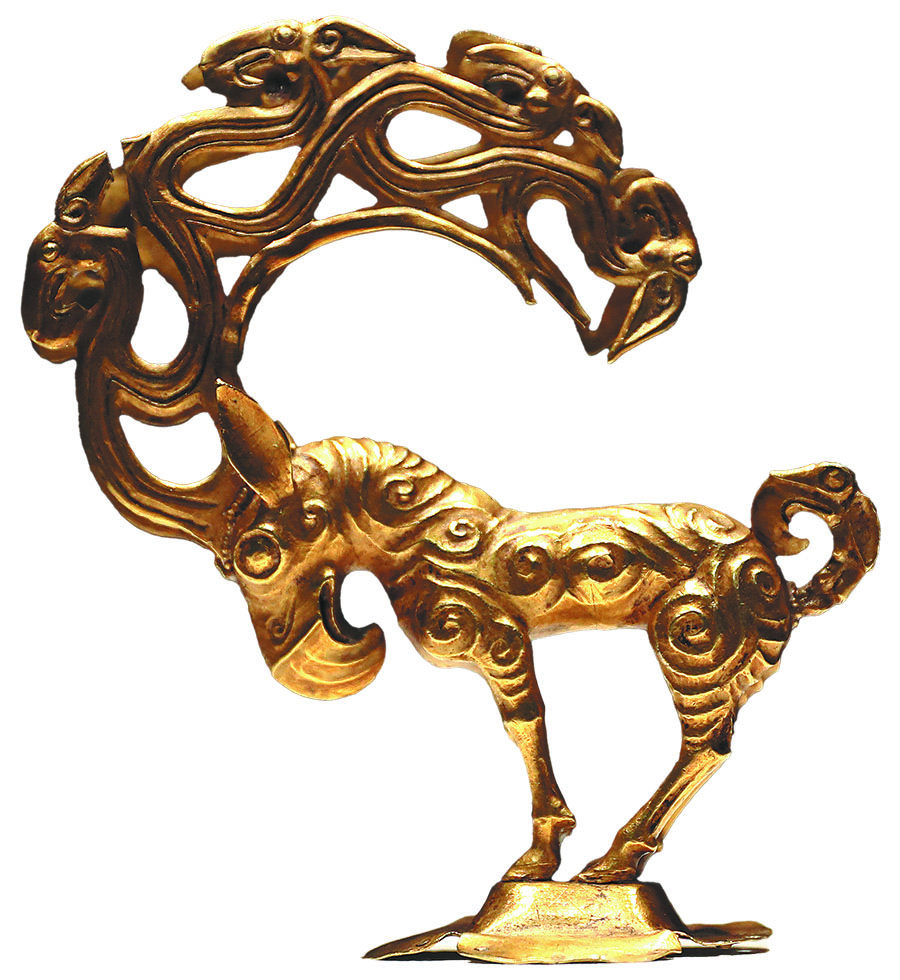
A gold decoration in the shape of a mythical beast at the exhibition.[PHOTO BY ZOU HONG/CHINA DAILY]
One multimedia exhibit illustrates the transformation of characters. Words stream toward a device in the center of the space, and then rise to the ceiling where they hang like stars in the sky. It follows changes all the way from the jiaguwen, or oracle bone inscriptions, the earliest known form of Chinese writing, to modern Chinese characters, and even to words in Japanese and Korean influenced by Chinese.
"This shows that the standardization of characters prompted the spread of Chinese civilization," Ren says.
One of the exhibits' highlights is a wooden Han boat unearthed at Weiqiao Site in Xi'an. It is on display for the first time.
"The boat is made of 16 planks, joined together by sunmao (mortise-and-tenon) joints. This method of building was found common in the Mediterranean area during Ancient Rome, but it is the first time it's been found in China," Peng says.
She adds that the usual way to build boats in ancient China was by carving one out of a single trunk, rather than by jointing planks. The adoption of this way of building boats shows that China's communication with the rest of the world was ongoing during the Qin and Han era, when the embryonic form of the ancient Maritime Silk Road began.
"The prosperous Qin and Han periods saw exchange with the rest of the world. … Since then, China has sustained the vitality of learning and communication with other civilizations with its open-minded and inclusive attitude," Peng says.
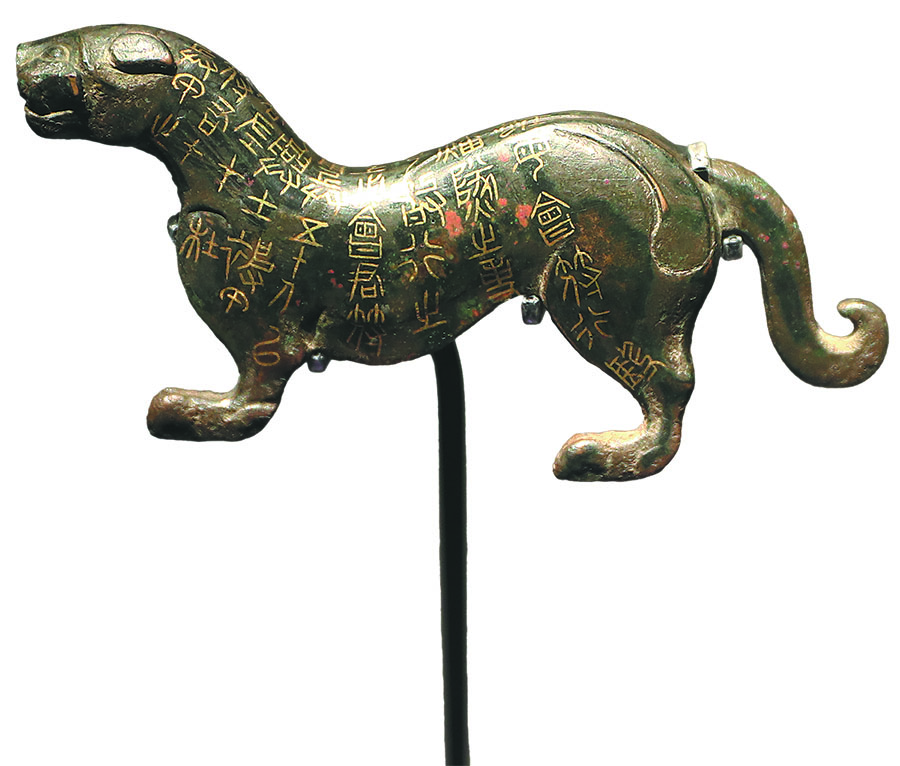
A bronze tiger that was presented to summon soldiers in the Warring States Period (475-221 BC) is on exhibition.[PHOTO BY ZOU HONG/CHINA DAILY]
The Shaanxi History Museum has a collection of more than 1.7 million artifacts, only several thousand of which have been exhibited before. With the opening of the new branch, visitors will have the chance to see more of them, Ren says.
For example, some small ceramic animal figurines of monkeys, camels and pigs, which are believed to have been Han era toys, were previously lost among the many exquisite artifacts in the Shaanxi History Museum's collection, but they finally have their chance to shine at the new museum.
The exhibition also makes a lot of comparisons between the Qin and Han civilizations and their foreign contemporaries. For example, when introducing the standardization of words, Persia's trilingual policy, its simultaneous use of Old Persian, Elamite, and Akkadian during the Achaemenid Empire (550-330 BC), is introduced by way of comparison.
According to Ren, since its soft opening at the end of last year, the museum has welcomed an average of about 10,000 visitors a day.
Two other exhibitions on the art of Qin and Han dynasties, and Qin and Han cities and tombs, will open in May.
"I believe the museum is very important as it explains important characteristics of Chinese civilization using archaeological evidence from the Qin and Han dynasties. Visitors will get the opportunity to understand how Chinese civilization has lasted for such a long time without interruption," Liu says.
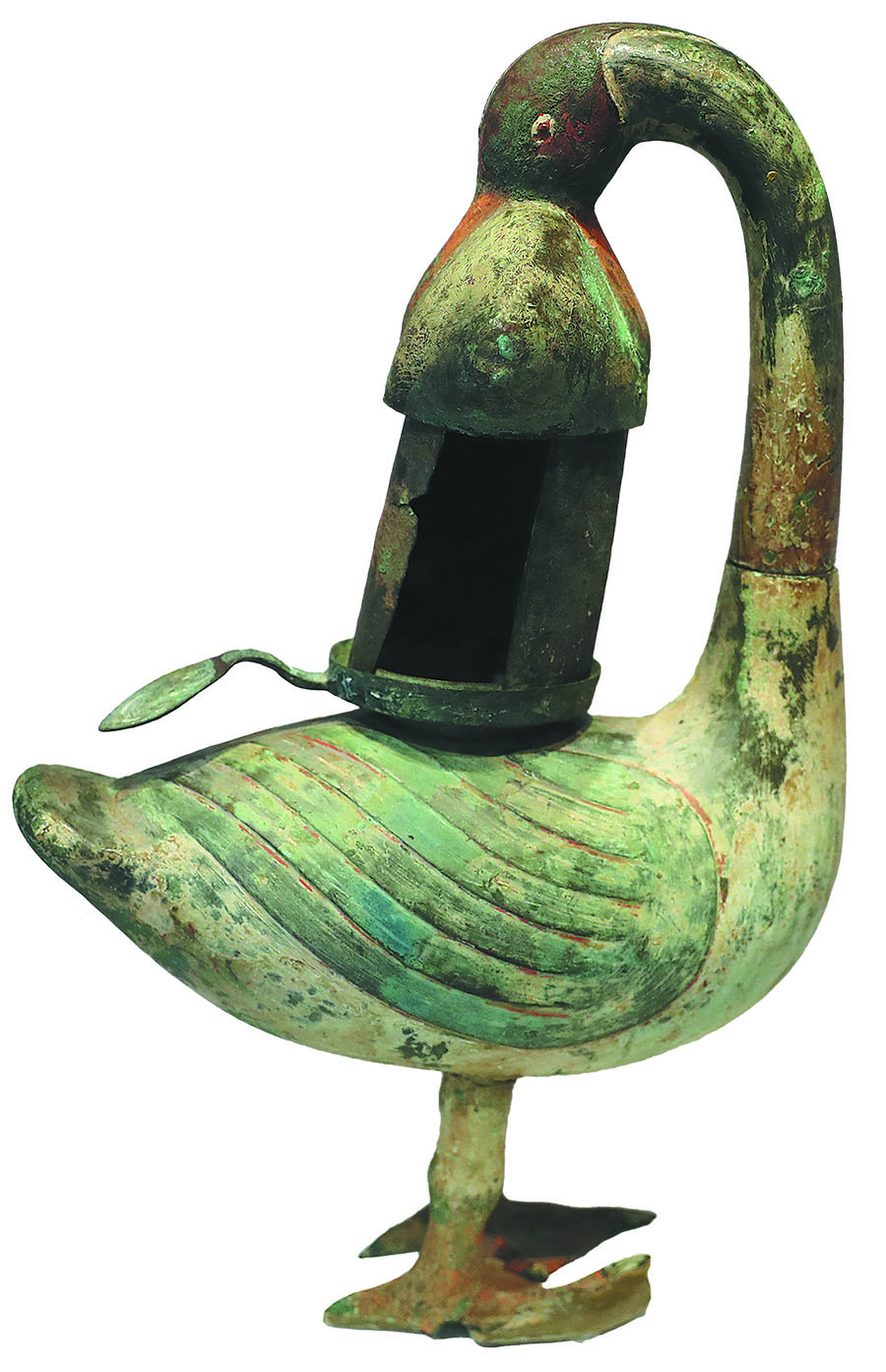
A painted bronze lamp in the shape of a wild goose chewing fish is on display.[PHOTO BY ZOU HONG/CHINA DAILY]
Edit:董麗娜
The copyright of the article and the picture belongs to the original author. If there is any infringement, please contact to delete it